You’re thinking about writing a novel – that people will want to read – and looking for guidance? This curated set of novel writing tips will steer you through the storytelling journey.
So, why is writing a novel so hard, and what makes a novel worth reading?
Is it the intricate plot twists, engaging characters, or being transported to strange yet familiar environments?
The answer is all of the above combined with self-discipline and practice.
If that sounds daunting, take a breath and relax.
Let the following practical tips, strategies, and snippets of wisdom from bestselling authors inspire you.
Ready to transform your writing dreams into reality?
O.k., let’s dive in.
The Foundations of Successful Writing

Image generated by DALL.E.
Before getting to the cool stuff, we must discuss self-discipline and setting realistic goals.
Writing is work. It requires planning and effort.
1. Set Clear Goals and Deadlines
A typical adult novel is between 80,000 and 110,000 words, and writing speeds vary between 500 words per day for beginners and up to 2,000 per day for experienced writers.
It can take 6 to 12 months to complete a novel, including outlining, researching, writing, and revising.
Unless you are a seasoned writer looking to transition into fiction writing, be realistic about your initial goals.
Consider starting with short stories between 2,000 and 10,000 words.
Get experienced with the entire writing life-cycle;
brainstorm/ideate – outline – research – write – revise – revise again – and again – then publish.
Rinse and repeat.
Learn from your mistakes and get used to dealing with failure – more on this later.
It’s better to experience rejection after a couple of weeks than see a year of your life dedicated to your magnum opus end in tears.
Quality consistently outperforms quantity.
Richard Bach’s Jonathan Livingston Seagull is only 28,000 words. It sold over 40 million copies.
Set daily, weekly, and monthly writing goals and stick to them come hell or high water.
Have a dedicated space, write daily, and make writing time inviolate:
- No interruptions.
- No distractions.
- No excuses.
If you are inclined to procrastinate, as 95% of the adult population are – the other 5% are lying – use a time management technique like Pomodoro.
2. Plan and Outline Your Novel
Image generated by DALL.E
Some experienced writers prefer to write “from the seat of their pants.” They balk at planning or outlining in detail and let the story unfold as they type.
Other experienced writers plan and organize their thoughts before starting the writing process.
There is no “one size fits all” formula; every writer determines what works best for them as they gain experience.
If this is your first attempt at novel writing, putting a basic outline together is a good idea. You can start with some basic questions:
- What sort of story will it be – historical fiction, thriller, mystery?
- How long will it be?
- When and where is the story taking place?
- Who are the main characters?
- What is their goal?
Once you have a high-level outline, you can create a schedule comprising:
- Completing any additional research that might be required before starting to write.
- The writing process itself – set a daily/weekly word count goal.
- The target date to complete your first draft.
- Review and refinement steps.
- A target date for your finished manuscript for publication.
You should now have an outline plan with measurable, intermediate goals and due dates.
Dates are essential for allocating your time and holding yourself accountable.
3. Research for Your Novel

Image generated by DALL.E
Writers are observant people. They take note of their environment, how it makes them feel, how it affects the people they observe, and how people react to each other.
The people around you and your own life experiences can be a rich source of ideas.
The sights, sounds, and smells from your experiences can trigger vivid memories and emotions your readers can relate to.
Colorful characters from your town or village, childhood memories from school, teachers, friends, events you witness, and the odd ways other people describe things can trigger ideas.
A co-worker’s vivid description of cleaning up the basement at the factory where they worked later became the basis of a Steven King short story, “Graveyard Shift,” initially published in an adult magazine:
“The rats down in that basement were big as cats” – he said – “Some of them, goddam if they weren’t as big as dogs.” – Steven King – On Writing: A Memoir of the Craft
If there’s one book on writing you should order today, this is it.
Beyond your first-hand experiences, reading will be your primary source of ideas and inspiration. If you’re already a voracious reader, you’re in a good place and excellent company.
All great writers advocate reading as a significant source of inspiration.
Reading a broad range of novels across different genres is essential to developing your unique voice.
Even non-fiction can be an unlikely source; this quote is from a Terry Pratchett masterclass lecture at Trinity College Dublin in 2010.
“You don’t know what it is until you’ve read it. Somewhere in a book on the history of false teeth there’ll be the making of a novel.”
Arminta Wallace’s synopsis of this lecture in the Irish Times contains some gems.
Do as much research as needed to ensure that your story is factually accurate regarding history, places, people, and the laws of nature, but don’t get bogged down. Those details are part of the back-story.
Allocate enough time to find authoritative sources and give you enough context to begin writing.
During revision, there’ll be plenty of time to validate details like exact dates when events occurred and the seasonality of flowering shrubs in the South West of England.
Be specific enough about facts to paint the picture of an environment and allow readers to fill in the gaps with their imagination.
Minor factual errors might slip by the average reader.
But most book critics examine writing through a different lens. They typically have low tolerance and short fuses.
In the age of social media, criticism can come fast and be ruthless.
Craft Your Compelling Story
All complete stories have a beginning, middle, and end.
The reader feels cheated or betrayed if one or more of these parts are missing or incomplete.
Novels can include multiple sub-plots and individual journeys the characters follow.
But everything leads to some conclusion that should leave the reader feeling fulfilled.
J.K. Rowling gave us a satisfactory conclusion to the Harry Potter stories.
But George R.R. Martin left us hanging with The Game of Thrones series. The prosthetic conclusion crafted by HBO didn’t do it justice.
4. Dive Deep Into Character Development

Image generated by DALL.E
The characters are the central pillars around which your story is woven.
Make your characters multi-dimensional:
- Give them motives, flaws, goals, and a physical description.
- Give your main characters a backstory. Use a slow reveal, and allow their story to develop.
- Create conflict and tension between the protagonist and antagonist. This Masterclass post describes how these and their supporting characters bring a story to life.
- Use all of your character’s senses to create an immersive world that your readers can experience.
Paint pictures with your words, but don’t overdo it. Give your readers space to create their own personal images.
Follow the “Show, Don’t Tell” principle when describing your characters in their settings.
Here’s an example of showing:
“He couldn’t breathe; he tried to close his eyes, to shut it out, but something held him, gripped with terror; it was inches from his face.”
And this is an example of telling:
“He’d always been afraid of spiders, and this one was huge.”
5. Balance the Three Elements of Fiction
Image generated by DALL.E
Keeping your readers engaged requires that narrative, action, and dialogue are all present.
Some scenes require the three elements to be balanced, but there are times when dialogue or action needs to be largely uninterrupted.
For example, when a scene revolves around the interactions between two or more characters in a bar or a station waiting room.
As dialogue occurs, they are aware of their surroundings, engaging in actions like eating, ordering a drink, or checking out the other people around them; is that someone they recognize?
Perhaps one of them overhears a familiar voice, and their demeanor suddenly changes; they become agitated, apologize, and abruptly leave.
Dialogue is where characters reveal their personalities, goals, conflicts, and flaws.
Great dialogue helps your readers become emotionally invested in the story. Action interspersed with dialogue keeps the story moving along.
This post from Writingforward.com goes into more depth on action and dialogue as storytelling elements.
6. Avoid Common Blunders
Don’t plagiarize. Passing off another writer’s work as your own is a definite no-no. It will damage your reputation and could land you in legal trouble.
But what about reading and research?
All great writers are influenced by what they read, as great musicians and artists are influenced by those who came before them.
Don’t overload your story with too much descriptive or flowery content. AZQuotes.com is a great source of quotes from famous authors on clarity and brevity in the craft of writing, like this one from James Kilpatrick:
“Use familiar words—words that your readers will understand, and not words they will have to look up. No advice is more elementary, and no advice is more difficult to accept. When we feel an impulse to use a marvelously exotic word, let us lie down until the impulse goes away.” ~ James J. Kilpatrick
Don’t mix Points of View. Be consistent when using first-person or third-person narrative for all characters throughout the story.
Don’t use adverbs, especially those that end in “ly.”
“I believe the road to hell is paved with adverbs, and I will shout it from the rooftops” Steven King – On Writing; A Memoir of the Craft
Thousands of overused words and grammatical errors can make writing bad or prevent good writing from being great.
This article from purpleshelfclub.com gives a good overview of the most frequent offenders, including clichés and overused metaphors.
Develop Your Unique Voice and Style
In response to this cry from the Twittersphere:
“I want to write like @jk_rowling or @StephenKing, but it’s too hard for me. I’m demotivated. I’ll never finish my book.”
J.K. Rowling replied:
“Don’t write me. Write like you. Nobody else can do that. Finish that book. x”
7. Blend the Four Writing Styles
Image generated by DALL.E
Formal definitions of writing style include:
- Narrative – classical storytelling.
- Descriptive – uses all five senses to bring writing to life for the reader.
- Expository – provides a detailed description of people, places, and things.
- Persuasive – attempts to change the reader’s mind.
Fiction writing blends narrative and descriptive styles to bring a story to life and make it real for the reader.
Expository writing uses extensive factual detail and might include formal proofs. It is used in technical and academic writing but can be used effectively in novels.
The blending of expository with narrative and descriptive styles in Tom Clancy’s earlier novels is masterful. His extensive knowledge of military technology is legendary, and The Hunt for Red October wouldn’t be the same without it.
When hearing a new song for the first time, we can often tell who the band is by their unique sound.
And so it is with writing; remember, fiction writing is an art.
The more you read and write, the more you develop your unique voice and story-telling style.
“You have to read widely, constantly refining (and redefining) your own work as you do so. It’s hard for me to believe that people who read very little (or not at all in some cases) should presume to write and expect people to like what they have written, but I know it’s true.” Steven King – On Writing: A Memoir of the Craft
Confronting Challenges and Staying Motivated
“I pinned my 1st rejection letter to my kitchen wall because it gave me something in common with all my fave writers!” J.K. Rowling tweet 4:52 AM · Mar 25, 2016.
Writing can be a lonely business.
Joining a local writing group or an online writing community is a great way to socialize with other writers and find support and encouragement.
8. Overcome Your Writing Fears
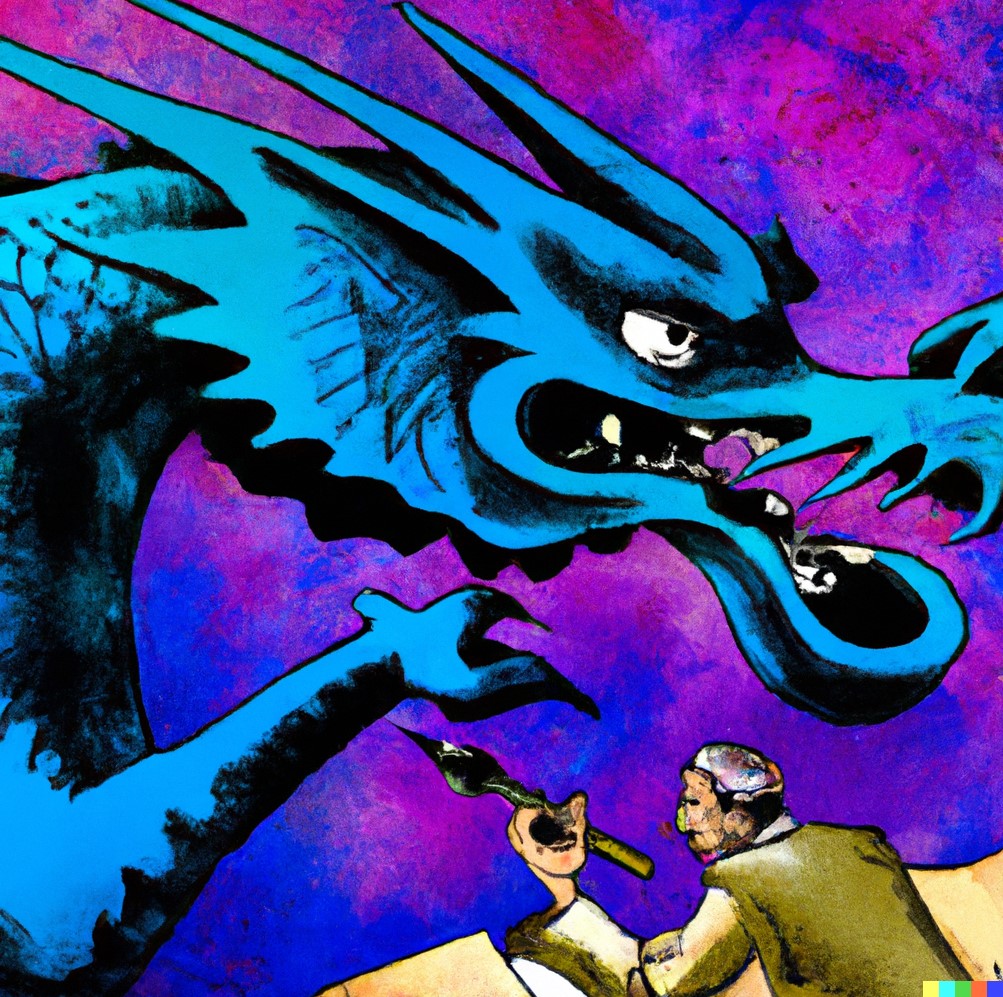
Image generated by DALL.E.
Kill the dragon with your pen.
Stage fright is as old as the art of public performance, and writing is no different.
The fear of rejection, ridicule, or appearing stupid is a potent inhibitor to exposing your inner creative self.
Mindfulness meditation is an excellent technique for getting into the right mental state to conquer fear and push through doubts and challenges.
At its core, meditation focuses on steadying and focusing your mind on your breathing.
You’re aiming for a steady, unhurried rhythm – slowly in and slowly out. On the “Out Breath,” you feel the tension falling away.
As you become more relaxed, the anxiety you previously felt becomes something you observe. Something you can measure. Something you can manage.
The adrenaline rush that once accompanied fear doesn’t go away totally. But what remains becomes a new source of creative energy.
9. Handle Feedback and Rejections
Remember, you’re writing for your audience, not for yourself.
Embrace constructive feedback with enthusiasm. It’s your most potent ally in gaining the trust of your readers.
Opinions are just that, opinions.
If some people don’t like your story, that’s their choice.
Some people don’t like broccoli. Everyone’s taste is different, so don’t take it personally.
Asking someone not to take criticism personally is easier said than done; even the greatest writers struggle with negative reviews.
Being part of a writing community can help deal with being criticized, especially in the early days.
Tools and Resources for Writers
Technology has revolutionized the writing process.
The disruptive impact of generative AI on all creative arts has been fast and furious, and the full extent has yet to be determined.
But it’s here, and failing to mention it at this stage would be a serious omission.
Tools like ChatGPT, Bard, and Claude can be great time savers for research.
These tools can also generate written text, and this is where the danger lies for creative writers.
ChatGPT could produce output based on a combination of the styles of Ernest Hemingway, Steven King, J.K. Rowling, and W.B. Yeats. But it wouldn’t sound human – at least not yet.
More importantly, generative AI will never substitute for the unique voice you develop as a writer by reading the works of these and many other authors.
10. Equip Yourself With Effective Tools
Select a set of tools that will help deliver your best writing and keep everything organized.
Word processors like Google Docs or Microsoft Word are fine for generating documents but don’t cut it for producing a book.
Modern, ‘AI-enabled tools for writers have built-in checkers to catch grammatical errors and detect plagiarism. Some have suggestions for improving plot clarity and character development.
These solutions also help with getting the job done. They include tools and templates to organize workflow, manage notes, research, and version control.
Many of these tools require a download and are available only for the macOS / iOS platforms.
Livingwriter.com is a cloud-based service focused on authors and screenwriters. It includes a rich set of workflow, version management, and integration tools. A 14-day trial is available.
Cloud-based tools require only a browser and, in most cases, an account. Many offer a free limited set of function or a trial period.
11. Websites for Writers
One of the benefits of joining a writing community is finding critique partners – experienced writers – who will provide constructive criticism and make you a better writer.
A local writing club is a great place to find support from experienced writers and build a new social network.
If that’s not available to you, there’s no shortage of online communities where you can share your work and get that all-important constructive feedback.
However, not all online communities are equal, and many target specific audiences.
This post from clevergirlauthor.com gives an up-to-date list and description of 19 online writing communities and the audience profiles they target.
Final Steps and the Business of Writing
All writers agree that the first draft is never the final product. Yet, they differ widely on when revision should happen:
Some writers advocate only starting the revision process once the first draft is complete, while Roald Dahl and John Updyke revise and edit continuously.
However you decide to work, remember your commitment to the schedule; if you find yourself still rewriting the first chapter after two weeks, change your approach.
12. Edit, Revise, and Polish

Reading your first draft aloud will reveal structural and style errors. You can also use a text-to-speech tool.
Listen for inconsistencies in points of view where a character suddenly reappears switched from first to third person or vice versa.
Now is the time to check for balance between narrative, action, and dialogue. Is the story moving along seamlessly?
It is best to put your first draft away for a while before doing a first review. This is true whether it’s a 2000 word blog post or 100,000 word novel. Getting away from it completely will allow you to read it with a fresh pair of eyes.
Your first review won’t be your last and chances are you’ll make a lot of edits during that first pass.
The second review is the time to fix all of the grammatical errors, typos and check factual details.
Then, prune mercilessly and eliminate weak words, flowery language, and redundant prose.
13. Get Published
For beginning novelists, publishing options include:
- Traditional publishing through literary agents and established houses.
- Self-publishing via platforms like Amazon Kindle Direct Publishing.
- Offering short stories to local newspapers and magazines. Steven King’s professional writing career started by sending short stories to magazines and newspapers and getting a lot of rejections.
The traditional publishing route to getting your work in print can be a mind-boggling task. But it is possible, and there is a process to follow.
The first task is finding a literary agent.
This post from Jane Friedman on how to find a literary agent provides a step-by-step guide, including an overview of the process, the role the agent plays, and how to get your work on their radar.
If you decide to try the self-publishing route, be advised there are a lot of scammers out there. This post from the Reedsy blog highlights some of the worst offenders and red flags to be on the lookout for.
The bottom line is if anyone offers to publish your work for a “small fee,” it’s almost certainly a scam.
Your First Masterpiece is Waiting

Image generated by DALL.E
There is a creative spark inside you that brought you to this point.
Let these novel writing tips fuel that spark and take you from writing your first story to becoming a novelist.
For your next step, start outlining your idea and dive deep into character development. Strong characters are the irresistible allure that keeps readers turning pages.
Develop your cast of characters and bring them to life. Let them breathe, excite, and surprise you.
Time spent writing is better than reading about writing, so hit those keys – or grab that pen – and let your story unfold.
Ready to enter the literary world?
Let your writing do the talking.
 Fairfield Insights LLC